← COIN ResearchClear queuesภาษาไทย
COINCIDENCE Algorithm · Live experiment

Knight’s Tour
Learning Lab

Watch an Edge COIN model learn directed transitions between chessboard squares. The experiment runs in a verified NumPy/Numba engine and reports compact progress without sending entire populations to your browser.

6364 visited squares · complete open tour64One legal return move · closed tour
Status
ready
Generation0
Best score
Elapsed0.00s

Best tour

Learning progress

BestAverage

Final Edge coincidence matrix

RESEARCH CONTEXT · LITERATURE REVIEW

Where COIN stands among Knight’s Tour methods

Knight’s Tour has constructive, heuristic, backtracking, evolutionary, neural, and ant-colony solutions. Their reported times are not directly interchangeable: some construct one tour using chess-specific knowledge, while others learn from candidate populations or enumerate diverse tours.

DIRECT CONSTRUCTION

Warnsdorff & Parberry

Warnsdorff chooses the legal continuation with the smallest onward degree. Parberry later presented an O(n²) divide-and-conquer construction for closed tours. These approaches are exceptionally fast, but they answer a different question: they embed Knight’s Tour structure rather than asking a reusable permutation learner to discover it.

Parberry, 1997 ↗
EVOLUTIONARY SEARCH

GA + repair

Gordon and Slocum evaluated 1,000,000 repaired strings over 20,000 generations per run. Their GA found tours in 94% of runs and averaged 89 distinct tours. Repair was essential: without it, the reported GA found no complete tour. COIN differs materially because it uses neither repair nor local search.

Gordon & Slocum, 2004 ↗
COLLECTIVE LEARNING

Ant Colony Optimization

Hingston and Kendall reported an average 488,245 unique tours, including 9,192 closed tours, from 100,000 cycles of 64 ants. This is a strong solution-bank baseline. However, each ant is constrained to legal, unvisited destinations, whereas COIN samples a complete permutation first and receives legality only through fitness.

Hingston & Kendall, 2004 ↗
PARALLEL MODEL

Neural computation

Takefuji and Lee formulated a parallel neural network for closed tours. It is historically important, but its neural dynamics, hardware assumptions, and stopping measurements are not equivalent to population evaluations in COIN; wall-clock claims should therefore not be compared without a common implementation.

Takefuji & Lee, 1992 ↗
WHAT IS DISTINCT HERE

A reusable learner—not a repaired or hand-guided tour generator

In our tested configuration (population 400), COIN achieved a 100% observed success rate, with the first complete tour always appearing before generation 300 and the earliest observed at generation 102—approximately 40,800 to fewer than 120,000 candidate evaluations. Runs also discovered closed tours, and continuing to 1,000 generations contributed multiple distinct records to the persistent solution bank.

  • No repair operator, backtracking, local search, or Warnsdorff guidance.
  • Uniqueness is guaranteed by permutation encoding; move legality remains a learned fitness signal.
  • The same COIN library extends beyond chess to TSP, Flow Shop, Sudoku, RNA, and Linear Ordering problems.

Scope note: these are observed results from our current runs, not a claim that COIN is the universally fastest Knight’s Tour algorithm. A definitive comparison requires the same hardware, seeds, stopping rule, open/closed definition, and evaluation budget.

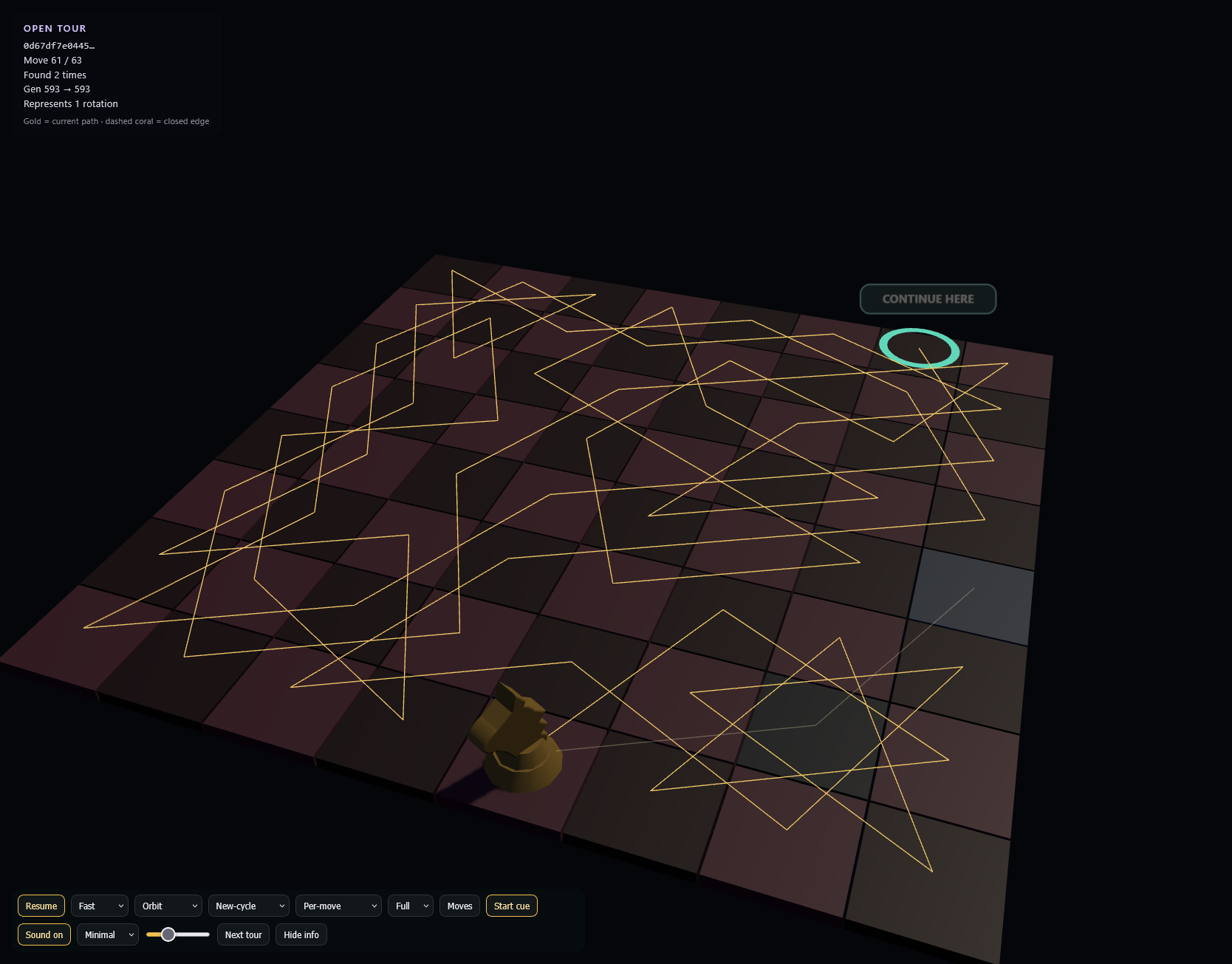
COIN Infinite Knight’s Tour rendered as a rotating three-dimensional chessboard
FROM RESEARCH TO COMPUTATIONAL ART

Let the learned tours become an infinite performance

Every stored solution can leave the laboratory and become motion, light, colour, camera work, and sound. COIN Art reads the persistent solution bank and stages each Knight’s Tour as a continuous three-dimensional performance; the algorithm’s output is no longer only a score, but material for computational art.

Your GPU, not ours. The browser renders the 3D scene on your device; our server only supplies compact tour data. Mobile and battery-powered devices may become warm.
Enjoy the performance in full screen ↗